Wednesday, December 18, 2013

How Danny Keefe Found His Voice - A Most Unusual Story

Danny at Apraxia Walk
By Jennifer Keefe

As a mother of four, my first job is to protect my children to ensure their safety, keep them happy and feel loved. With Danny, my instincts to protect are very different than how I want to protect his siblings.


Danny has childhood apraxia of speech (CAS) and was diagnosed at 3 years old. When asked how he compared to other children with CAS, I was told he was severely unintelligible. They didn't have to tell us that we already knew it as we had a very difficult time understanding him. Although his siblings could understand most of what he said and could help us out.

At home, Danny is treated just like his siblings. No special treatment just another member of the Keefe household. Sometimes I would forget he had trouble speaking and communicating clearly until we left the safety of our house and I would hear children younger than him speaking clearly. It was especially hard watching his younger cousins speak so clearly when he struggled so much. His cousins have always supported him, they say cousins become your first friends, we believe that.

I was afraid to send Danny to school for fear he would get picked on by classmates. It was so hard to let him go off to school when my instincts were telling me to hold on and protect him from potential hurt. I knew I had to send him, he needed it and was ready even if I wasn't.

His years in preschool went well. He made friends. We all felt safe. Then it was time for kindergarten. His first year was OK, some children questioned why he talked the way he did, did he speak Spanish and although they weren't picking on him, the words hurt Danny deeply. I still remember Christmas of 2012 when the biggest gifts he asked for was a world globe. When I asked Danny why he told me so he could show his classmates he was from America like them and not from another part of the world. He wanted them to know that was just like them. My heart broke. I couldn't stop this from happening to him. That year Santa brought him his globe and he was so happy!


Another thing happened that year is that Danny decided he was most comfortable in a suit and hat. He wears a suit seven days a week and walks with confidence, as he should!


This year, Danny repeated kindergarten, not just because of CAS, but it did play a role in our decision. This time, though, he would go four full days and one, half day, which meant he would be at school all day and have to go to recess and lunch. While he was very excited about this, I cringed. I knew for some children that these were times of the day when they should be carefree can sometimes be the worst part of their day.  For Danny that became true.

For the most part, he has more great lunches and recess outings than bad, but when they are bad he cries and I cry. Truly, as a mom, it is the most helpless feeling not to be there to protect your child from bad things happening to them. When he would come home upset we talked about it as a family and our motto was, "it doesn't matter what people think of you it only matters what you think of yourself." It was hard saying it when Danny's heart was breaking, but my husband and I believe this. We would also talk about all of the great people in his life.

One day Danny came home and told me how two little boys took his hat off, threw it and then proceeded to throw mulch in his hair. I was so angry - beyond words - and I wanted to march on that playground and speak to those little boys, but Danny looked at me - not even angry - and told me, 

"It doesn't matter what they do, Mom.  It only matters what I think of myself."  
What I didn't expect, but should have realized, was how these stories were also affecting his siblings. His oldest brother Tim was deeply upset by what was happening to his brother. Tim didn't tell us; he confided in his friends. The friends were so impressed that a six-year-old said that it didn't matter because it only matters what he thought of himself, that one 11-year-old boy started a movement.  The boy didn't know it at the time, he just wanted to support Danny and show Danny that he loved him by also wearing a suit and fedora to school. Then the word started to spread through the entire 5th grade football team that November 20, 2013 was going to be "Danny Keefe Awareness Day." There were 45 boys who came to school to show my son, Danny Keefe, that they love and support him.

My wish has come true.  Danny is protected and it doesn't always have to be just my husband and I, but that our community is also there to help him!


Since November 20th our lives have changed. Locally, schools are sponsoring Danny Awareness Days and everyone dresses in suits and hats. His story is being told in classrooms near and far. This story has been aired locally and nationally. Most recently, Danny sat across from and spoke with Ellen DeGeneris on The Ellen Show and then demonstrated to the world his famous dance moves. 


Even though Danny has Apraxia, Danny's voice is being heard by millions and I'm not afraid for him anymore - (well maybe a little)! He is one of the strongest, most self confident people that I know. We are so proud of him, our family, community and all of those people out there that have taken the time to reach out to us. We feel very blessed and lucky to have this support for our little Danny Keefe.  


As a mom it felt great that the lessons we were teaching actually were paying off, but I felt terrible that he had to endure even an ounce of pain. 

Tuesday, January 8, 2013

The Relationship Between Treatment Intensity & Treatment Outcomes for Children with Apraxia of Speech

by Aravind Namasivayam Ph.D. S-LP(C)

Childhood Apraxia of Speech (CAS) is in terms of diagnosis and treatment a very challenging and complicated speech disorder in children. Children with CAS find it difficult or impossible to accurately produce speech sounds and/or words despite having a good understanding of language. Although there are several treatment approaches for CAS, there are very few published studies examining their efficiency and effectiveness. For example, at present, we do not know the amount of change in speech intelligibility (the degree by which their speech can be understood by a listener) or their ability to communicate effectively in real world situations (i.e., functional communication) following treatment. We also do not know if more intense treatment (although promoted by most clinicians) is actually better for this population.  Thus, there is a strong need for well-designed research studies in this area to advance clinical practice.


In July 2011, the Childhood Apraxia of Speech Association of North America (CASANA) awarded a competitive clinical treatment research grant to Dr. Aravind Namasivayam of the Speech and Stuttering Institute in Toronto, Ontario, Canada. His team consisted of experts in the areas of CAS research (Dr. Ben Maassen, University of Groningen in the Netherlands), speech science (Dr. Pascal van Lieshout, University of Toronto in Canada) and speech disorders treatment (Ms. Margit Pukonen from the Speech and Stuttering Institute, Toronto, Canada). The CASANA funding was used in support of the research project titled “Exploring the Relationship Between Treatment Intensity and Treatment Outcomes for Children with Apraxia of Speech”. 
Using the funds from the CASANA grant a specialized screening tool was developed to identify a subpopulation of two to five-year-old children, who demonstrated characteristics of CAS, from a larger database of 102 preschool age children with motor speech issues. All children received a specialized motor speech treatment program delivered by qualified speech-language pathologists in one of two possible treatment formats: high-intensity (2 times a week for 10 weeks) or low-intensity (1 time a week for 10 weeks).  Each speech therapy session lasted for 45 minutes. The speech-language pathologists providing the treatment were randomly assigned to either of these treatment formats. A child’s ability to correctly produce speech sounds in words, speech intelligibility and functional communication were evaluated both before and after treatment. Speech intelligibility was assessed at the word-level (percentage of words correctly identified by a listener) and at the sentence-level (percentage of words correctly understood in imitated sentences by a listener).

Overall, the results of the study demonstrated that the outcomes of the high-intensity treatment were superior to those of the low-intensity treatment. Specifically, high-intensity treatment resulted in a significant change in a child’s speech production abilities, word-level intelligibility and functional communication when compared to low-intensity treatment.  Furthermore, high-intensity treatment produced almost twice the amount of positive changes and had fewer children failing in treatment (i.e. not showing any real progress- especially for speech production) relative to the low-intensity treatment.  However, neither high- nor low-intensity treatment improved sentence-level speech intelligibility in children with CAS.
This CASANA funded study represents the largest data set available to-date relating the amount of therapy induced change and treatment dose and its effects on speech intelligibility and functional communication outcomes in children with CAS. The results from the study could be used to set appropriate levels of clinician and parental expectations prior to treatment and could potentially guide clinical practice (e.g. amount and possibly type of treatment required for this population).

Importantly, even though positive changes were found for speech production and functional communication in CAS children with 20 sessions (2 times a week / 10 weeks) there was only minimal improvement in sentence-level speech intelligibility following treatment. Thus, the CAS children may benefit from more than 20 sessions of therapy and from a treatment program that systematically builds in practice of speech production targets in longer utterances (i.e. phrases, sentences, connected speech). At present additional analyses are being carried out to identify factors contributing to positive outcomes in children with CAS. For example, we ask which of the following factors affect a child’s treatment outcomes: child’s participation in the therapy process, amount of home practice and/or quality of parent-child interaction? With further analysis, we will be able to identify key factors that contribute to positive treatment outcomes in children with CAS and thus make a significant contribution to future clinical practice in this area.

[CASANA funded research dollars are raised through the Walk for Children with Apraxia]


Thursday, December 13, 2012

Exploring New Treatment Methods for Childhood Apraxia of Speech

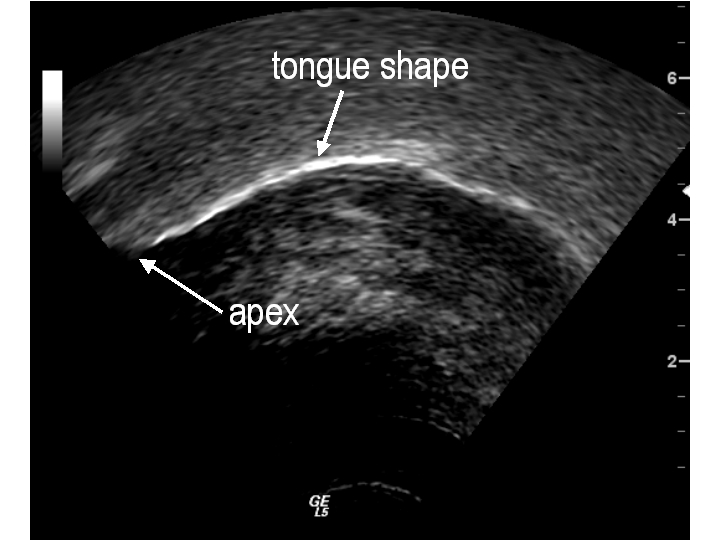
A study funded by CASANA was completed by Dr. Jonathan Preston, a researcher from Haskins Laboratories (www.haskins.yale.edu) and Southern Connecticut State University. The research involved using ultrasound (the same device used to obtain images of a fetus or heart) to provide a real-time visual display of the tongue. The ultrasound transducer is held under the chin, and the ultrasound images are then used to teach children how to move their tongue into different positions to produce certain speech movements. Speech-language pathologists can use this information to provide the child with cues about the tongue.

One advantage of using ultrasound biofeedback for children with persisting speech errors is that both the clinician and the child have more information about what the child is doing with the tongue when he or she speaks. Additionally, clinicians can provide more direct and explicit cues to the child, such as “move this part of your tongue up here,” and the child can readily see if the movement was produced properly.

Among the disadvantages of this approach are the cost of the equipment (the ultrasound probe costs about $5,500) and the need for clinicians to be trained in the approach.  Presently, only a few clinics in the country are using ultrasound biofeedback therapy. In general, children younger than 7-8 years are probably not good candidates for this type of therapy because it requires a great deal of focus and is not as “play-based” as some other therapy approaches.

The target group of children for this study was children who had speech errors that had not resolved by the age of 9 years.  Six children, ages 9-15, participated in the study for 18 therapy sessions. All children had been resistant to traditional treatment methods and were showing limited progress in their school-based speech therapy programs.  All of the participants in the study showed improvement in their speech sound accuracy on treated sounds, and all parents reported improved speech intelligibility.  Specifically, each child achieved 80% accuracy or higher on at least two treatment targets, and some children showed substantial generalization to sound patterns that were untreated.  Dr. Preston cautions that not all children necessarily respond equally well and that further research is needed. However, the use of ultrasound biofeedback therapy holds potential to become another tool in the toolbox for treatment of children with persistent speech errors.
 
Dr. Preston has recently applied for federal funding to continue to support this research.
 
[Note: CASANA research grants are made possible by funds generated by the Walk for Children with Apraxia]

Monday, October 8, 2012

An Open Letter

By David Ozab

To the anonymous donor who gave $60 to Team Anna for our 2012 Walk for Children with Apraxia of Speech:
 
I want to say "thank you." I know the chances of you reading this post are very small—perhaps infinitesimal—but on the slight chance you see a link to this post, I want to tell you a bit about the girl you're supporting and the many kids like her.
 
Anna is an amazing girl. I know I'm biased since I'm her dad, but she really is. She is six-and-a-half and she just started first grade: she loves to read, to swim, and to perform for anyone who'll watch, or when she's alone in front of a mirror. She wants to be an actress and I think she'll be a good one: we're looking into classes for next spring.
 
But to act she has to be understood and that's a challenge for her. At two-and-a-half years old she was diagnosed with Childhood Apraxia of Speech. CAS is a motor-speech disorder where her brain knows what to say but the mouth can't keep up. It's a spectrum disorder: some kids don't talk at all while others talk non-stop but can't be understood. Anna was in the latter category: she still is, but thanks to almost four years of intensive speech therapy, we now understand her most of the time. She's not done yet, but she's come a long way.
 
Speech therapy has made a huge difference in her life and we are grateful to all the speech language pathologists (SLPs) she has worked with over the last few years. SLPs undergo intensive training in order to work with children with CAS, and CASANA helps fund some of that training. They also fund research, iPad app development, and outreach to over 350,000 people each year through Apraxa-KIDS.com, the Apraxia-KIDS blog, and social media sites like Facebook and Twitter. None of this would be possible without donations like yours.
 
Every year, kids with Apraxia and their families participate in walks across the country to raise money and awareness. Last year, we walked with a small group of families in Salem, Oregon, and despite registering just before the deadline we still raised $360. This year, with more time to plan, we hoped to do better.
 
We did. My wife's employer gave us $1000 (meeting our original goal) in early-September. Friends and family contributed too. And Anna decided to do her part. She saved change from household chores in a special Apraxia piggybank, set up a lemonade stand during a church garage sale, and contributed half of the money she made selling her pre-school aged toys in the same sale. She raised $50 all by herself, which we matched to bring her total contribution to $100.
 
After the sale was over, we submitted her contributions to our fundraising page, leaving us only $60 short of out new goal of $1350. I posted the story of her lemonade stand on both Facebook and Twitter and with less than two weeks to go we hit our goal.
 
Thanks to you, anonymous donor.
 
It's been said by many people that the greatest testimony to a person's character is what he or she does when no one is looking. This contribution, however big or small it may seem to you, is a great testament to your character. You didn't give it in hope of recognition. You knew that no one would ever know your identity and yet you gave anyway.
 
We will never know your name, but we will always be grateful.
 
Sincerely,
 
David, Julia, and Anna Ozab.

______________________________________________________________________________________________
Biography: David Ozab is currently editing and revising his first non-fiction book, A Smile for Anna, which tells the story of his daughter’s cleft diagnosis and surgery, her difficulties with speech, and her incredible outgoing spirit through it all. He is a Contributing Editor at About This Particular Macintosh and a Guest Contributor at MyEugene. His writing has been (or will be) featured such diverse publications as Chicken Soup for the Soul, Errant Parent, and Catholic Digest. He is a stay-at-home dad and blogs about parenting and life at Fatherhood Etc (http://www.fatherhoodetc.com). He lives in Oregon with his wife Julia, his daughter Anna, and two lop rabbits named Jellybean and Oreo.


For more information on David Ozab, visit his website at http://www.davidozab.com/ 

Tuesday, March 13, 2012

A Bit of an Accent

By David Ozab

“Will my child be accepted?” It’s a question every parent asks, particularly parents of kids with Apraxia of Speech. I’ve asked that question myself many times. My daughter Anna has always made friends easily, but as other children her age became more verbal, I began to notice a barrier forming between her and them. It’s been two years, but this incident still sticks with me. She had just turned four, and it was the first time she was excluded because of her Apraxia.

We were at our local mall's playland that day—one of Anna’s favorite places to play. She likes the waterfall themed slide, the hollow log topped with a lounging bear, and the big red canoe. I like that there's only one way in or out so it's easy to keep an eye on her.

I sat by the entrance as I always do. I had my notebook at hand to catch any cute or funny things Anna might say. She ran around, slid down the slide, and made friends with all the kids—it was spring break so there were lots of kids to play with. She approached an older girl who was sitting on the bear and asked the same question she always does:

"Do you want to play with me?"  The girl didn't understand, so I repeated it.

"She got a bit of an accent," the girl replied.

"Yeah," I said. "She's in speech therapy."

The girl shrugged her shoulders, slid off the bear, and ran over to the slide. Anna followed, of course, like she always does when she wants to be friends.

A few minutes later, I saw Anna talking to the older girl, who sat by the slide with two other girls closer to Anna's age. The girls struggled to understand Anna so I walked over and helped translate:

"She said 'My name is Anna, what's your name?’”

"I'm Whitney," the older girl said.

"Do you want to play with me?" Anna asked again. I repeated what Anna said so the girls would understand.

"This game's for three," Whitney said. "I'm the mommy cat, and they're the kittens."

I wasn't sure if the girls were excluding Anna on purpose, or if they’d created a three-person game, but I quickly thought of a way they could include her.

"Can't there be three kittens?" I asked. "Like the song?"  I sang a verse of The Three Little Kittens. Anna and the two younger girls smiled, but Whitney shook her head.

"This is a different game.” She got up and walked away. The two younger girls followed her. Anna started off too, but I called her over.

"Anna, they’ve already started their game."

She pouted. “But I want to play with them.”

"There are lots of kids here. Why don't you find another one to play with?”

I gave her a hug and sent her on her way. Within five minutes, she and another girl were running around the play area, sliding down the slide, and laughing. She was over the snub.

But me? Not so much. It's something I've worried about since she was first diagnosed with Apraxia. She's always made friends so easily, but as she grows older, will she be seen as different and shunned by some of the kids? Her speech is improving rapidly, but she may need years of therapy to be completely understandable and even then she may never lose her "accent."

How will she handle the rejection? How will I? How much do I shield her? How much do I let her experience so she can learn to take it and ultimately ignore it?

Those questions were on my mind the rest of the day, and they’ve nagged at me ever since. Every time she enters a new social situation, I always wonder if she’ll be singled out because of her speech.

Almost two years have passed since that day at the mall. She’s six now, and has just started the second semester of Kindergarten in our neighborhood public school. She still has trouble being understood at times, but she's had no trouble making friends. Her outgoing personality and our constant encouragement have made a big difference. So has her ongoing therapy. Other than her “accent,” her classmates see her as another girl in their class.

If you are a parent of a child about to enter school, and you're worried about how your child will fit in, I hope that I've eased your worries a little bit. Yes it can be difficult, but in my experience it's never as bad as we imagine it will be. Take advantage of all the support that's given to you, and then let your child have fun.

______________________________________________________________________


Biography: David Ozab is currently editing and revising his first non-fiction book, A Smile for Anna, which tells the story of his daughter’s cleft diagnosis and surgery, her difficulties with speech, and her incredible outgoing spirit through it all. He is a Contributing Editor at About This Particular Macintosh and a Guest Contributor at MyEugene. His writing has been (or will be) featured such diverse publications as Chicken Soup for the Soul, Errant Parent, and Catholic Digest. He is a stay-at-home dad and blogs about parenting and life at Fatherhood Etc (http://www.fatherhoodetc.com/). He lives in Oregon with his wife Julia, his daughter Anna, and two lop rabbits named Jellybean and Oreo.

Links:

David Ozab: Writer http://www.davidozab.com/ Salem, Oregon 

Thursday, January 26, 2012

Early Advocacy Made the Difference

By Sheri Larsen

As the mother of three young children, I figured I’d seen it all from ADHD, tonsillitis, surgeries, colds, and runny noses. I was wrong.

CJ was born on a crisp November day in 2003, two weeks earlier than expected, and with a true knot in his umbilical cord. He should not have survived.

Feeling tremendously blessed, we took CJ home and, for the next six months, went about the busy life of raising four children. The latter half of his first year was spent with picture books in his hands and puzzle pieces scattered on the floor. He was fanatical about pictures. So much so, that by twelve-months old he had mastered 60-piece puzzles with no aid at all, pointing out objects in the pictures. He figured out how to communicate his wants and needs. I used to joke, calling it our private language. He excelled in every area of growth, except for the normal sounds babies make.

His first birthday came and went, but did not take with it his inability to make sounds other than the grunts and groans we’d grown accustom to. With no improvement in articulating formidable sounds over the next months, I spoke to our pediatrician about my concerns. She set up an appointment for CJ, who was 22 months old at the time, to be evaluated by a speech therapist. Her trust in me as a parent would never be forgotten.

CJ was officially diagnosed with Apraxia of Speech.

Hearing CJ’s diagnosis being described as a neurological disorder could have crippled me. Instead, I collected research and questioned his two therapists on ways I could help him at home in addition to his therapy regiment. I searched magazines, the internet, and any other source to find pictures of everything under the sun. Shrinking the images and laminating them into a deck of cards made it easy to take to any ice rink or field my older kids were playing at. We would use car rides as therapy by flipping pictures to CJ and encouraging him to form the sounds. My older children helped, too. Slowly we saw improvement.

As a family, we dedicated ourselves to learning sign language and used amazing DVDs to do so. Once CJ was given his “Picture” book, he could hand us little images of his wants and needs. It was then that I finally understood what he had been telling me all along.

CJ had lots to say. He only needed help finding his voice.

My greatest joy was the first time I heard him say, “Mama.”

The next three years were spent in therapy, where CJ and his therapists developed a fond relationship, one that would unexpectedly follow him into elementary school. There, he entered special services for speech therapy. His original therapist took a job at the school and could keep an eye on CJ, one of her star little guys. We were so blessed.

But soon, it was evident that CJ had met and even surpassed the official state benchmarks to receive services any longer. It was then that an image of a chubby 22-month-old sitting at a lone table in his therapy room and swooning over the mini M&Ms, which had become his expected reward during speech, wafted across my mind. I knew how hard he had worked. I had educated myself enough about Apraxia to know that it could continue to affect him as his vocabulary and the demands on his system increased, especially around third and sixth grades. I could not let his hard work go to waste.

Through my advocacy, CJ was allowed to remain in speech therapy for the remainder of kindergarten, first grade, and the beginning of second grade. He is still in the second grade and was recently discharged from the program; however, I asked for a written agreement, stating that CJ will be allowed back into the program, with ease, if his speech skills backslide when entering third grade. Given that his original therapist is at the school, I am confident she, as his advocate, will insure CJ’s continued care.

The most important message I have through CJ’s story is parental advocacy. There is nothing wrong with standing up for your child’s well-being, as long as it is delivered in a positive manner. Parents can be their child’s voice, until he or she finds their own.

Every child deserves a voice.

More about Sheri Larsen


Sheri Larsen is a published freelance and short story writer, and KidLit author. Her current YA novel is with literary agents, and she’s preparing to sub one of her picture books to agents. Her website, Writers’ Ally (http://writersally.blogspot.com), is where she explores writing, children’s literature, and motherhood. She lives in Maine with her husband and four children.

Tuesday, January 3, 2012

Father Leads Team to Raise Awareness and Over $22,000 in 2011 Denver Apraxia Walk


(Top Photo from left to right: Jill (Gillian) Green, Saoirse Green, Dan Green, and Siobhan Green; Bottom Photo: Siobhan Green)

On November 15, 2011, Team Leader Dan Green of Westminster, Colorado was selected to win an iPad for his efforts of raising $20,861.31 for Team Siobhan, bringing his team total to $22,053.31 in the Denver Walk for Children with Apraxia of Speech. CASANA selected Green as the Team Leader of the Top Fundraising Team out of a total of 44 Walks held all over North America.

However, for Green, his family, and his team, the incentive was more than winning an iPad; it was about raising awareness in his community and while doing so, raising funds to better the future for his four-year-old daughter, Siobhan, and other children with Apraxia.

When Siobhan was around the age of two years, Green and his wife, Jill, noticed she was not speaking, prompting them to take immediate action like any other parent. From researching online, getting involved with a local county program, to hiring a private speech-language pathologist, they were determined to find answers and to get a proper diagnosis for her. It was not until nearly a year later that she was formally diagnosed with Childhood Apraxia of Speech (CAS).

“CASANA raised awareness so that Siobhan could be diagnosed, and early enough so that we could make an aggressive push to get her to articulate,” said Green, a consultant to startups and venture capital firms. “It was very helpful to go through all the research on the CASANA website and understand what we would be dealing with. The Walk in our area was also instrumental in getting us in touch with other parents of children with Apraxia in the area, allowing us to establish a local social network.”

This network included contacts to trained speech therapists and information that made Green a “smarter consumer of speech therapy services” which introduced him and his wife to techniques that would best help Siobhan resolve. After receiving this help, Green wanted to do more for Siobhan and for CASANA, so he decided the 2011 Denver Walk for Apraxia was his opportunity to do so. When he became aware of CASANA’s iPad prize to be awarded to the Team Leader of the Top Fundraising Team, Green decided to make this his goal; he wanted to win the iPad for Siobhan so that he could help her learn language and help reduce her frustration level.

So with a clear target in sight, Green developed a strategy that combined his passion for photography and knowledge of business he obtained from Harvard University. He gathered several photos of Siobhan he had posted on his Facebook and he drafted letters that could be customized later. Next, he compiled a list of contacts from social media websites including his Facebook and LinkedIn profiles, both of which have a combined 835 personal and professional connections. His determination to reach his goal allowed him to see every person in these networks as a Walk contributor and a supporter. He felt the more people he reached was one less person he had to give an explanation to about his daughter having Apraxia.

“Folks raising money on behalf of the kids shouldn’t feel shy about approaching anybody, as long as there’s a personal connection. You’ll be surprised who’s going to donate. Our donors included two bestselling business authors whom I know and have worked with,” said Green, who found a surprising number of people he reached out to also have kids with Apraxia. Furthermore, most were talking about their child having Apraxia for the very first time outside of their immediate families and donated because they were glad an organization was finally there to support kids with Apraxia.

Green managed his fundraising goal continually by changing the amount a few thousand dollars at a time, so that it would only take 10 or 20 donations of average size to reach it. Ultimately, he wanted donors to know they had a real impact in helping him reach his goal.

“None of the past donors object if you’ve been successful enough to raise the bar a bit more,” said Green. “They usually applaud the success. Somewhere in the back of my head I thought we’d raise around $10,000 but I didn’t want to put that into print because it’s too unattainable to the average donor,” said Green. “Then we blew through $10,000 and I started to think about $20,000, but even then I didn’t put it in print.”

Green’s strategy zeroed in on prospective donors who looked for clues about average donation size when asked to “give from the heart.” He explained that providing guidance to prospective donors and how the question was framed really made a difference in a donation size. For example, he would ask for a donation of $10, $25, $50; of $50, $100, or $250; or of $100, $250, or $500, depending on what the prospective donor’s capacity was and what their willingness to give would be. He also utilized additional page features, such as the ticker and thermometer widgets to help guide and nudge the donation levels up.

“We went to people we thought would be $500 to $1,000 donors first; they were the pacesetters,” Green said. “We made sure that group included senior family members and colleagues whose names on our ticker would be a beacon for other donors. Then we stepped down to folks who were earlier in their careers and had less capacity to give.”

He felt that anchoring at higher numbers from respected members of the community, which people could see on his personal donation page, enticed people who would not have given to give and those who would have given anyway, to give more. Finally at the end he asked people of some means to stretch a bit and to help him make his then-goal of $20,000; a goal that at one point he was at risk of missing.

“We thought we were tapped out at around $18,000, then saw some extraordinary generosity by people who love Siobhan and really wanted to help in her name,” said Green. “They’d been holding out because they wanted to be Team Siobhan’s second wind.”

In the middle of all of this, a crucial moment for Green helped him find more motivation to keep going beyond his goal. “Siobhan got flustered while trying to tell me about a doggie she saw,” he said. “She cried, held her tongue, and signed, ‘Daddy, help me talk.’”

Pushing all doubts aside, Green continued to support his daughter by raising a total of $20,868.31 in his enthusiastic campaign. With a couple of additional donations and company matches, his team’s total reached over $22,053.31 for the 2011 Denver Walk for Children with Apraxia of Speech.

“Following up with donors to ask for a company match is usually well-received, as it's often not much work on the donor's part and is a great way for the donor to magnify the impact of his or her donation,” said Green. His widespread reach included a total of 186 individual donors that as a result would help support CASANA and benefit important funding for future programs and research.

To find out more about the Walk for Children with Apraxia of Speech, visit: http://www.apraxiawalk.org/


Wednesday, November 30, 2011

YOU'RE A STAR

This poem was written by 10-year-old Megan Stephens. She wrote this poem for her younger brother, Dawson, who has apraxia.


Through my sight,
I can see your fright,
But it’s alright.
It’s not your fault.
You’ve done nothing wrong.
I know that you are strong.

You may have trouble talking,
But that doesn’t make you any different.
No one is the same,
And there should be no shame.

Some people may be mean,
And it doesn’t make it right,
But on your face,
I can still see the light.

When I hear your voice,
It makes me smile.
I would love to hear you talk to me
For a while.

You may have trouble talking,
But that doesn’t mean a single thing,
Because you are everything
To me.

Now I can see your strength.
I can’t even measure its length.
You know that you are amazing,
And you truly are
My star.

Thursday, October 13, 2011

Telling Anna's Story

By David Ozab (Writer and father of a daughter with Apraxia)

I didn't plan on becoming a writer, but I have a story to tell. The story of a little girl who knew what she wanted to say but couldn't make the words come out right. It's a story you probably know and share—why else would you be reading this blog?

It's the story of a girl in search of her voice. Her name is Anna, and she has Childhood Apraxia of Speech.

It took us a while to realize there was something wrong, but about the time she turned two we started to suspect it. I remember one day in particular. My wife Julia and I had taken Anna to our local Gymboree studio for open gym when a little voice caught our ears.

"Help please, mommy."

We turned to see a small boy struggling to climb up the ladder behind Anna. His mom leaned down and gave him a boost.

"Thank you," he said as he climbed the rest of the way up the play structure set in the center of the multi-colored classroom.

"He's a beautiful little boy," Julia said.

"Thank you," his mom replied.

"How old is he?"

"Eighteen months."

The words hit as hard as if the play structure had collapsed on top of us. Eighteen months old and his speech was clear and fluent. Anna was seven months older and we couldn't understand her.

That's when we knew there was something wrong, but we didn't know what it was yet.
Now Anna has always been a smart, creative, and outgoing child. She was already recognizing a handful of sight words and communicating with us as best as she could. We practiced by writing words on her Magna Doodle:

C-A-T

"Meeeow." She couldn't say "cat" yet but we knew what she meant.

D-O-G

"Rffff." A bark.

P-I-G

"Doh, doh, doh." Her approximation of an oink.

She was obviously smart and she knew what she wanted to say. She tried to communicate with us, but we only understood her about ten percent of the time. Mostly she babbled to herself or her toys. Every so often, though, she would ask for something and we'd have no idea what she wanted. I remember one evening in particular when she walked in our living room and announced:

"Awaem oobie ees."

"What's that honey?" Julia asked.

"Awaem oobie ees."

"I have no idea," I said.

She made the sign for eat, putting her hand up to her mouth.

"Awaem oobie ees."

"Eat," Julia said. "Eat what?"

"Oobie."

"Oobie?" I asked.

"No," Anna replied. Her "no" was unmistakable. "No oobie, oobie."

Anna folded her arms in frustration. It was hard not to laugh at the gesture, but at the same time I felt so bad for her.

"It's something she wants to eat." Julia said.

Anna smiled and nodded. "Oobie."

"So it's food, two syllables?"

"Great," I said. "We're playing charades with a two year old."

"You're not helping.

"Sorry."

Anna put her hands on her hips. "Oobie ees." The hands on the hips were even cuter than the folded arms, but we kept our laughs to ourselves.

"Oo - bie ees?" Julia sounded out the words, grasping at each syllable as it passed over her lips.

I joined her. "Oo - bie ees."

Over and over we both said it. "Oo . . . bie . . . ees." Then it hit me.

"Cookie please?"

Anna smiled and nodded again. "Oobie ees." She sounded so happy.

Julia got up and got Anna the cookie while I smiled back at Anna. I was her hero for the moment, but before long I'd be that stupid grown-up who couldn't understand her.

It frustrated Julia and I as much as it frustrated Anna. We knew she was smart, we knew she understood us, yet she just wasn't able to say what she wanted to say.

Now this may sound strange, but we were fortunate that Anna had been born with a cleft lip. We took her to Doernbecher Children's Hospital in Portland for her surgery at four months old and returned annually for visits with the various members of their Cleft Team. Up to this point, we hadn't seen their Speech Language Pathologist, but given our concerns we made an appointment.

The SLP saw Anna twice—in April and then October of 2008. The diagnosis? Childhood Apraxia of Speech. The recommended treatment? Speech therapy, twice a week.

She began therapy right after her third birthday. When she started, she was all but unintelligible, but within the first year she made tremendous strides. By the time she turned four we could understand about 75% of what she said and total strangers got about half. She's progressed even farther since then, and though we still don't understand her all the time she is mostly understandable, even to strangers. She started kindergarten in September and has transitioned into a public school environment with no difficulties.

And now we want to give back, so we are participating in our first Apraxia walk in Salem, Oregon, this Saturday. Marcie Phillips organized the walk in honor of her three-year-old daughter, Addison, who is the same age Anna was when she began her therapy. We hope that our participation will help her and so many other kids facing the same struggle Anna has faced every day for the last few years: The struggle to be understood.

Every child deserves a voice.


Biography: David Ozab is currently editing and revising his first non-fiction book, A Smile for Anna, which tells the story of his daughter’s cleft diagnosis and surgery, her difficulties with speech, and her incredible outgoing spirit through it all. He is a Contributing Editor at About This Particular Macintosh and a Guest Contributor at MyEugene. His writing has been (or will be) featured such diverse publications as Chicken Soup for the Soul, Errant Parent, and Catholic Digest. He is a stay-at-home dad and blogs about parenting and life at Fatherhood Etc (http://www.fatherhoodetc.com/). He lives in Oregon with his wife Julia, his daughter Anna, and two lop rabbits named Jellybean and Oreo.

Links:
David Ozab: Writer http://www.davidozab.com/ Salem, Oregon
Apraxia Walk:
http://www.apraxia-kids.org/salemwalk/davidozab

Wednesday, September 28, 2011

Walking for Apraxia & Learning that THIS is OUR thing

By Kari Weed (SLP & mom of daughter with apraxia)

We had the walk last Sunday and it went unbelievably well! The day started out a little crazy. We woke up to downpours and threats of thunder and lightning. Bill and I decided we needed to change the park that we were originally planning on having the walk in, to a park with a shelter. We made some phone calls and then it went much better. The weather was okay, we had a huge turnout and as of date we have raised almost $10,000.00! My mom flew up for the walk, both of Bill's parents were there and his brother and sister. We had cousins, aunts and Lucy's Godmother and friends attend and were all decked out in our "I love Lucy" attire. It was wonderful! We felt so supported and I realized that there is a "village" that is cheering, supporting and loving Lucy! There were two experiences that day, that gave me goosebumps.


When I woke up that morning I was very proud of the money we had raised but felt that I wasn't sure if I would do it again next year. I don't like asking people for money, nowaday there are walks for everything and it took a lot of my time. But, then these experiences happened:

Experience #1

There was a 19 year old girl at the walk named Elizabeth. Elizabeth was at the walk with her mom and had joined a local team with out even knowing the kids. Elizabeth is 19, attending UW and has apraxia! She has been in therapy since she was 3, but did not get a diagnosis until she was in 2nd grade. Elizabeth's mom stated that she has been waiting for the northwest to finally recognize apraxia and they were so thankful to be there. I talked to Elizabeth and was intrigued by the way she talked. Her speech was in her throat, kind of like glottal sounds. It was different, but not too different. I found myself listening to her and praying that Lucy will talk that well someday! Her mom was so thankful and Elizabeth was very proud. She knew how hard she had worked and this group of people are the only ones who would understand that!

Experience #2

A dad walked up to me after the walk and asked if I was Kari Weed? I said "yes" and he said, "Thank you for organizing this walk, for the first time ever, I heard other children who speak like my son. Thank you." I had tears in my eyes by the time we were done talking.

Now we will be organizing this walk every year! After the walk was done and we cleaned up, some of our family came back to our house. We toasted with champagne, ate chicken wings and then crashed for a great nap! After nap time we again met with family and had a celebratory dinner. It was a wonderful day!

I have learned that yes there are walks for everything, but this is our thing. These parents and kids need a place to see that other families are dealing with the exact same issues. Our kids were celebrated that day. Our kids who get the dirty looks in restaurants when they scream a lot because they cannot talk; our kids who we all fear will never speak; our kids who we love so much and we would do anything to give them a voice. Yes, we will be planning this walk again next year because this is our thing.

Thank you everyone who supported us!

[Special Note: CASANA thanks the volunteer efforts of Kari Weed and all the Walk for Apraxia volunteers who dedicate their time to bring awareness to their communities, and so much more.  At the Walk for Apraxia you are among "your people", those who understand just what you are going through and share the struggle and the hope.  The Walk for Apraxia also raises important funding for programs and research.]

Friday, September 9, 2011

Triathlete Luke Farrell Takes on World and Speech Dyspraxia

Written by: Roy Elmer, Luke’s Grandfather

Please Note: Terminology used throughout this story, such as Speech Dyspraxia, is the same as Childhood Apraxia of Speech.

Triathlete, Luke Farrell, has had Speech Dyspraxia, SLI 5-6, since birth. Now 18, Luke is in his final year of school at Immanuel Lutheran College at Buderim on the Sunshine Coast. He also just received advice of another selection in the Australian team to compete at the World Junior Championships in Beijing, China in September 2011. He is widely regarded as an outstanding young man and a rising talent in the junior elite level Triathlon in Australia and internationally.

LUKE’S EARLY LIFE—A ROUGH RIDE.
At the age of four years, while living in Brisbane, Australia, Luke had not begun to speak and was diagnosed by a government department psychologist as having autism spectrum disorder. At this departmental officer’s direction, he was transferred from his local kindergarten to a “special” preschool, attended by children with serious disabilities. Luke was surrounded by youngsters with serious developmental and behavioral problems and had some disturbing experiences. These experiences created great angst for his parents regarding the short and long term effects. His parents made several approaches to the Education Department to sanction withdrawal or transfer, but nothing was achieved.

Once Luke reached primary school age, he was sent to a “special education unit” at the Mt. Gravatt East primary school in Brisbane. This brought new challenges for Luke, struggling to separate the teacher’s voice from other sounds in his surrounding environment and unable to comprehend the lessons. In attempt to cover this, he began to imitate other student’s reactions and behaviors, only to mask further the true nature of his problem. As time progressed, his family became aware that the only appropriate intervention he was receiving was one half hour every fortnight of speech therapy. His tuition time was shared with six other students and other lessons/services provided to Luke were of no benefit. His parents saw him being prepared solely for a life of limited expectations as a disabled person.

A GLIMMER OF LIGHT.
Luke’s first signs of an improved prognosis appeared only after he had the good fortune of being referred to Jane Remington-Gurney for speech therapy. Jane runs a company called “Options” Communication and Speech Therapy, operating at the cutting edge of the science of her profession. Upon the first meeting and subsequent consultation processes with Luke, Jane diagnosed Luke's condition as Verbal Dyspraxia, a disability presented as a speech language impairment, SLI 5-6, and a hearing and comprehension difficulty. Following Jane's diagnosis, Luke was referred to Dr. Ross, a specialist in Autism disorder and president of the Autism Association in Australia. At this consultation, Dr. Ross agreed with Jane’s diagnosis in which Autism was eliminated and Verbal Dyspraxia, SLI 5-6, was confirmed.

PATHWAY FORWARD.
Luke's parents were determined to give him, for the rest of his school life, the opportunity to keep in touch with his own peer group by finding and establishing his own level in his future. Their hopes were pinned on the private school sector, combined with continual monitoring and guidance from his speech therapist, Jane. The next step was to find a private school willing and able to accept the challenge of providing Luke a place in one of their classrooms as well as a meaningful education. Finding it proved to be very difficult as their search extended beyond Brisbane. It was not resolved until the principal at Immanuel Lutheran College, Buderim, called a meeting of the staff members who would be involved in delivering Luke’s education program. They accepted the challenge and for the first time Luke enrolled at Grade 3 to a normal classroom. The very next day the family relocated to the Sunshine Coast. This was an enormous dislocation for Luke’s parents who were faced with many challenges, including selling the family home and managing their Brisbane based business from 100 kilometers away.

Although it was understood that given the delayed start to education proper, Luke would have significant hurdles to overcome to graduate from high school. Guidelines were put in place to ensure minimum targets were achieved for Luke to have the ability to interact with other members of mainstream society, to have a positive self-image, and sufficient life skills to make his way in life. Happily, this target has been surpassed with already several bonus outcomes. Luke’s easy going nature attracted friendships essential to peer group acceptance. His shy but honest modesty following his successes with his sporting endeavors reflected credit on his school and firmed up his friendships, all of which are fertile ground for the formation of a healthy self-image and self-esteem.

SPORT—THE KEY TOWARDS NORMAL LIFE.
The role that Luke’s participation in sport has played in his progress towards a normal lifestyle is impossible to ignore. At the age of thirteen, after watching a televised triathlon event, Luke announced he was going to become a triathlete. Although he had never owned a bike or displayed any particular talent for running, he did not regard this as an obstacle. His parent’s only reaction was by providing encouragement, support and opportunity. That year, Luke entered the Mooloolaba Triathlon in the "come and try" series. This proved to be the most enjoyable experience in which he competed successfully. In the next four years, Luke’s progress displayed a rise through district, regional, and Queensland representative levels as he participated in state teams that won the Australian team’s championship, and then the honor of representing Australia in a triathlon. Luke appeared to make a quick and smooth transition from a “nobody” to “a big time somebody.” Nothing could be further from the truth.

In late 2008, Luke, who was only 15-years-old at the time, was producing impressive performances in the Gatorade age group events held in Queensland. As a result, he was contacted by the Triathlon Australia and with only one week’s notice to the first event, he was advised to compete in the South Australian, West Australian and ACT Triathlon State, under 19 age group, Sprint Championships. These races formed part of the selection trials for the Australian team to compete in the World Triathlon Sprint, under 19 age group, Championship. Luke finished first in Gleneg, South Australia; and second in both Rockingham, West Australia and Canberra. ACT. After returning home, Luke competed in the remaining events, winning the “Gatorade” series in his age group in Queensland, across six triathlons at different venues. These performances had been the reason for his gaining selection in the Australian team for his first time.

Following his results in special trials, he received advice from the Queensland Academy of Sport that he was an automatic selection in the Triathlon Queensland Junior Emerging Triathlon Squad (JETS). Shortly after, he also received advice from Triathlon Australia of his selection for their 2XU National Junior Development Camp. He was advised that his selection was based on his “Commitment, Attitude and Performance” and importantly, his “potential to become an elite athlete.” He would receive this invitation again in 2011.

In 2009, 16-year-old Luke was one of the youngest triathletes selected to represent Australia at his first ever World Junior, under 19 age group, Sprint Triathlon Championships on the Gold Coast. He finished in eleventh position in a field of 57, under 19 age group, competitors from around the world. After outstanding performances in 2010 state and national competitions and selection trials, he again achieved selection in the Australian Team for the 2010 World Junior Spring, under 19 age group, Triathlon Championships held in Budapest, Hungary. The domestic season finished in mid-March so Luke had only six months of training with no competition until the race itself in September. Despite these conditions, Luke finished in fourth place.

After resuming from his rest period after Budapest in late 2010, Luke competed and finished seventh place in his first elite Open Men’s triathlon event, the Queensland Triathlon Gatorade No. 1 race. From there he went on to achieve his third consecutive win, blitzing the field by a full two minutes, in the Queensland Triathlon “All Schools” 2010 championships. In 2011, he finished in second place at the Open Men’s event for the Gatorade No. 2 race at Robina on the Gold Coast, followed by a win in the Gatorade Bribie Island Junior, under 17 age group, Triathlon. Both proved to be just a warm-up for the Triathlon Australia, under 19 age group, championship held at Canberra in which he discovered his racing bike had a crack in its frame just before leaving. He still managed to finish second place at the 2011 Australian Championship event on a borrowed bike.

Over the next few months, Luke learned about the impact of illness on training and competition performance. He suffered a series of health challenges, including an ear infection, a virus and ultimately bronchial pneumonia, losing 5kg of body weight. Luke’s training load and competition schedule were reduced and he displayed great courage in persevering, especially with team events. Although the past few months have been a little quieter as a result of his ill-health, the exciting news is Luke’s selection again for the 2011 World Junior, under 19 age group, Triathlon Sprint Championship to be held in Beijing, China.

Luke’s support group is happy with his progress, despite the setback caused by his untimely illness. He is considered to be on track with his goal of life as a professional triathlete. After returning from a necessary rest period ordered by his coach, Luke entered the Hervey Bay “Olympic Distance” Triathlon to record a base time to qualify for future major events; Luke finished in fifth place in this Open Men’s competition. While there, Luke found himself competing against one of his idols, Courtney Atkinson. They talked after the event and instantly became friends. Today, their friendship continues by keeping in touch through Facebook. It is Luke’s sporting achievements that have opened doors to conversations like this, which were never dreamed of in those difficult early years.

TIME TO MAKE A DECISION ON A FUTURE LIFE.
After Luke finishes school in late October 2011, he will begin life as a semi-professional triathlete until he achieves his license as a professional. He will then be nearing the end of his third year of a four-year Operational and Strategic plan, put together by his family support group who were drawn together by Luke’s determination to succeed. He also aims to be a professional coach of these skills later in life, a remarkable ambition for a lad with Verbal Dyspraxia. Luke’s story reveals great strength of character, dedication and determination to succeed. His diagnosed medical condition is incurable, however Luke has used his sporting experience and successes to throw off its shackles and earn the admiration and respect of his peer group, both at school, in sport, and in the broader community. He has not cured himself of his condition, but has learned to “live with it.”

His appointment as captain of the Sunshine Coast Secondary schools regional team in 2011 indicates the respect he has earned from the regional team’s management. The team members and other competitors accept him into the peer group unconditionally and as a teenager living with Verbal Dyspraxia, Luke is immensely proud of his achievement in making his first public speech on accepting the trophy on behalf of his team.

In his short eighteen years to date, Luke Farrell has trodden over more obstacles, overcome more fears and moved further beyond his comfort zone than many people are asked to do in a lifetime. The simple act of mixing with his peers and fellow athletes who enjoy fluent communication skills has tapped his reserves of intestinal fortitude, and his peers’ lives have in turn been enriched as they have come to grips with communicating with Luke. Luke hopes his story, which basically comes down to accepting his situation, learning to cope with it as best he can, looking to his strengths, and getting on with life, will offer hope and support to individuals, parents or families facing similar challenges.

For more information go to Luke’s Website: http://www.lukefarrell.com.au/

E-mail: roy@lukefarrell.com.au

Monday, August 1, 2011

Truth or Misleading? “Children with Apraxia of Speech Make Very Slow Progress”

The Childhood Apraxia of Speech Association of North America (CASANA), along with members of its Professional Advisory Board, has engaged in discussion about the misleading impression that children with apraxia of speech make very slow progress in speech therapy. Some children are diagnosed with Childhood Apraxia of Speech (CAS) by speech-language pathologists who are using “slow progress” as the differential characteristic of the disorder. Is it true that children with CAS make very slow progress in therapy? Here is what we think:
  • Children with apraxia of speech often make slower progress than children with other types of speech sound disorders. (Note: slower than other types of disorders; not slow in and of itself)
  • Children suspected to have CAS but who make very rapid progress in speech therapy that generalizes easily to new contexts, both in and outside of the therapy room, most likely have a phonological disorder and NOT CAS..
  • With appropriate goals, informed by detailed assessment – AND – appropriate, well executed speech therapy that incorporates principles of motor learning, children with apraxia of speech can be expected to make good, steady progress in therapy, especially those with age appropriate or near age appropriate cognitive and language skills.
  • Both parents and SLPs should not blindly accept that, “progress will be or is slow because the child has apraxia.”
Discussion:

Speech progress may be very slow, even with appropriate planning and therapy, when other co-existing problems add to the challenges, including delayed cognition and/or receptive language, poor attention or behavior, and other significant speech diagnoses such as dysarthria. Additionally, children with CAS who are in poor health and not able to take full advantage of the learning and practice opportunities available to them, may demonstrate very slow progress in speech production skills.

With appropriate goals and intervention, parents of children with apraxia as the primary diagnosis should expect progress in their child’s use of intelligible words within a three-month period. (Children with apraxia plus other complex challenges likely will have more limited progress.)  If this progress does not occur for a child whose primary diagnosis is CAS, an SLP should consider the following questions:

  • Is the diagnosis correct?
  • Are the goals and stimuli appropriate?
  • Are there additional diagnoses that should be considered, in addition to CAS?
  • If there are other diagnoses, is one of them really the bigger challenge to the child’s speech production skills?
  • Is the intensity of speech practice, both in therapy and at home, sufficient?
  • Is the frequency of direct speech intervention sufficient?
Remember that although speech progress can be slower for children with apraxia than it is for children with other speech problems, there should be noticeable and ongoing progress in the child’s ability to independently produce intelligible words. While their words may not be “perfect”, one can observe increased movement toward intelligibility. Parents will want to be in contact with their SLP to discuss expectations and what modifications the SLP will make if progress is not being made.

Tuesday, July 19, 2011

Interview with Dr. Aravind Namasivayam

CASANA has awarded an Apraxia Treatment Research Grant to Dr. Aravind Namasivayam of the Speech and Stuttering Institute in Toronto, Ontario, Canada for his proposal, “Exploring the Relationship Between Treatment Intensity and Treatment Outcomes for Children with Apraxia of Speech.” Other co-investigators on this grant include Ben Maasen, Ph.D. of the University of Groningen, Netherlands; Pascal van Lieshout, Ph.D. of the University of Toronto; and Margit Pukonen, M.H.Sc. of the Speech and Stuttering Institute.  We interviewed Dr. Namasivayam about the grant project and that interview is below.

CASANA:  Why do you feel this study is important?

Dr. Namasivayam: There are a number of factors that may contribute to treatment outcomes in children with Apraxia of Speech (CAS) ranging from frequency, intensity and type of practice sessions to amount of home practice, parental involvement/participation parental skill and treatment fidelity, yet there is little empirical data regarding how these factors actually contribute to treatment effectiveness. The present large scale multi-centre study is the first of its kind to investigate:
 a) the magnitude of treatment effects,
(b) the relationship between treatment intensity and outcome measures and
(c) to identify the key factors that contribute to treatment effectiveness of motor speech treatment for this population.

For example, at the present time we do not know if the intensity of treatment (1x versus 2x a week) plays a role in determining the magnitude of treatment effects when controlled for treatment duration (10 weeks), or what are the effects of parental training and home practice on speech intelligibility and functional communication. Having this information will help us refine and guide clinical practice (e.g. service delivery models for this population).

CASANA:  In what ways do you anticipate the study being most successful?

Dr. Namasivayam:  We feel that the study will contribute significantly to the understanding of how the service delivery models (e.g. treatment intensity) affect treatment outcomes in CAS. This information could then be used to justify treatment schedule changes and funding allocation for treatment of this population. Also, findings of the study will yield important information relating to the impact of parental training and home practice on treatment success. This information can be discussed with parents to motivate and increase their participation in the therapy process. Finally, information on magnitude of treatment effects for outcome measures related to speech intelligibility and functional communication is limited for this population. Knowing magnitude of treatment effects is important for two reasons: (a) it can be used to set appropriate levels of clinician and parental expectations prior to treatment, and (b) it allows for planning of future studies in terms of study design and sample size.

CASANA:  What are the biggest challenges you will face with this study?

Dr. Namasivayam:  The biggest challenge as with any large scale multi-centre study is to limit inter-clinician and inter-clinic variability and make treatment replicable. We have taken a number of steps to ensure both quality and quantity of treatment is delivered as intended. For example, all clinicians prior to participating in the study were given a structured 30 page manual, had to attend 2 rigorous multi-day workshops on assessment and treatment of children with motor speech disorders, had to complete 2 online video based assignments, and pilot the treatment protocol as a case study in their own clinics. These procedures were developed to allow us to maintain a high degree of treatment fidelity across clinicians and clinics. Additional challenges include getting ethics approvals from a large number of centers and hospitals within a short period of time, and finding sufficient assistance and financial resources to meet project timelines.

CASANA:  When this study is successfully completed, what future research do you expect?

Dr. Namasivayam:  We hope to continue several lines of research based on the factors that may contribute to treatment outcomes in children. For example, we would like to investigate how a clinician’s skill level and training may affect treatment outcomes or how a clinician’s accuracy, timing, and type of cueing in treatment alters treatment outcomes for CAS. These are critical follow-up questions to this project.

CASANA:  What are your thoughts on CASANA's Apraxia Treatment Grant Program?

Dr. Namasivayam:  Through it's research program, CASANA is fostering exciting research that will help us develop a deeper understanding of CAS and how to treat the disorder more effectively. Our research team would like to extend our sincere thanks to CASANA for providing us with the opportunity to contribute to this cause.

It is expected that about 200 children with motor speech issues will be participating in this study, with a significant portion of them displaying signs and symptoms of CAS as defined in the 2007 ASHA technical report. Without the financial help of CASANA we would not be able to identify, analyze, and report on data relating to treatment effects in this subpopulation of CAS within the larger motor speech research study.

We hope that the study will provide concrete information on the impact of service delivery models (e.g. treatment intensity), parental training and home practice and magnitude of treatment success. Based on the findings of our study, we would be better able to justify changes to service delivery models and funding allocation for treatment, and to motivate and increase parental participation in the therapy process, allowing clinicians to develop appropriate levels of parental expectations and finally, to permit future researchers to plan appropriate study designs and estimate sample sizes. In this manner we feel that the proposed study directly relates to the mission statement of CASANA: “To strengthen the support systems in the lives of children with apraxia, so that each child has their best opportunity to develop speech”.